
Past wounds / 過去の傷
日本語は下へスクロールしてください。
Last month, my left big toe became so swollen that walking was difficult. As I went to see a doctor, he immediately made a small hole in my toenail. Fluid that had built up due to inflammation drained out through the hole, relieving the pressure on the nail—and to my surprise, the pain was instantly and dramatically reduced.
Recently, I participated in a five-day debriefing in Germany, and it felt very much like that toenail experience: this time the inner/mental/psychological pressure was released.
In a church context, debriefing refers to a process in which people who have served abroad or worked in cross-cultural settings reflect constructively on their past experiences, emotional burdens and feelings. The purpose is to care for the heart/mental health, share lessons learned from the field, and discern future directions for ministry.
Of course, life abroad/in the oversea field includes many positive and joyful experiences. However, a debriefing intentionally focuses mainly on difficulties and negative experiences.
On the first day, I created a chronological timeline of the “facts” (what has happened) from the past five years categorising them with the 5 Cs: Change, Concerns, Criticism, Conflict, and Crisis.
On the second day, I listed how those events had affected me.
On the third day, I wrote down the emotions that arose from those events.
On the fourth day, I asked God whether I had come to believe any lies as a result of those events and its impacts, and my instructor/therapist and I identified those lies.
Finally, in and through prayer, we broke those lies one by one and replaced them with the truth of God’s Word.
Because other people are involved, I will not mention any specific details from the debriefing. However, I would like to share one major discovery. I hope it may be of some help to someone in the body of Christ.
I am, by nature, someone who likes people and is interested in them, regardless of age, gender, nationality, religion, or language. However, on very rare occasions, there are people I struggle with—what you might call “people you dislike”. In my forty years of life, there have been five such individuals. They share common traits: being self-assertive and intimidating, two-faced, lacking respect, talking behind someone's back, and disturbing peace and harmony of a group.
Of those five, two are people I have “forgiven” many times. And yet, whenever a trigger is pulled in my mind, I find myself nearly swallowed up by a spiral of negative thoughts.
The situation that causes me the greatest emotional damage in relationships is being “ignored”. When I greet someone and receive no response. When I send a message and get no reply. When a message is marked as ‘read’ but there’s no response—the damage is doubled. (Of course, I’m sure there are times when I, too, have “ignored” messages (not intentionally though), and I’m sure there are people who find me difficult or dislike me. So, it goes both ways.)
For years, I had been asking myself—and praying to God—why I struggle so much with people like these above-mentioned five, and why being ignored affects me so badly. During one debriefing session, I was confronted with these questions: “What message do you unconsciously receive when interacting with people like these five?” “Why does being ignored affect you so strongly?”
As I sought God in prayer, the phrase “I’m nobody” came to mind— “I have no value.” At the same time, a childhood memory involving my father resurfaced.
My dad was what you would call an intellect or “excellent student.” He was intelligent and quick to learn new things. He often compared me, the eldest son who struggled academically, with my sister, just one and a half years younger, who excelled in school. She was well-rounded, both studying and sports.
One evening, as the three of us—my dad, my sister and I—got into the car to go shopping, dad’s criticism on me began immediately. That day, it escalated into insults and personal attacks that shredded my self-esteem. The Toyota Estima, an eight-seater that usually felt spacious to an elementary school child, suddenly felt like a narrow prison cell. I remember desperately wanting to escape, yet being unable to flee the moving “prison,” and feeling an intense sense of anguish.
It may have been at that moment that the seed of performance-oriented self-worth —which I’m now trying to uproot—was planted: I understood that the only way to have my existence acknowledged by my father was to produce good performance and results.(For more details please see the blog in December 2025.)
My father passed away before reaching 60, and now there is no way to talk with him about the past. (That he accepted Jesus and was baptized two months before his death is a miracle and a great comfort from God.)
When I think about it rationally, being ignored is not such a big deal. More often than not, there is no ill intent. People may simply not have noticed my greeting, been just busy, forgotten my message, or assumed a reply wasn’t necessary. There are also surely some of you who are totally fine with such above-mentioned five individuals.
Yet because of my past experiences and misinterpretations, I get and believe the lie - “I am nobody”, and old wounds begin to ache. Perhaps, in order to avoid having those wounds touched and to prove my worth, I have been frantically trying to achieve good performance and results.
On the final day of debriefing, I broke this lie in prayer and replaced it with God’s Word: “I’m nobody” → “I am a child of God; I am loved by God.” (Romans 8:38–39, John 1:12, Galatians 3:26)
Then I also forgave those five people in prayer. But this was something I had done many times before, and still, bitterness would arise whenever I remembered them.
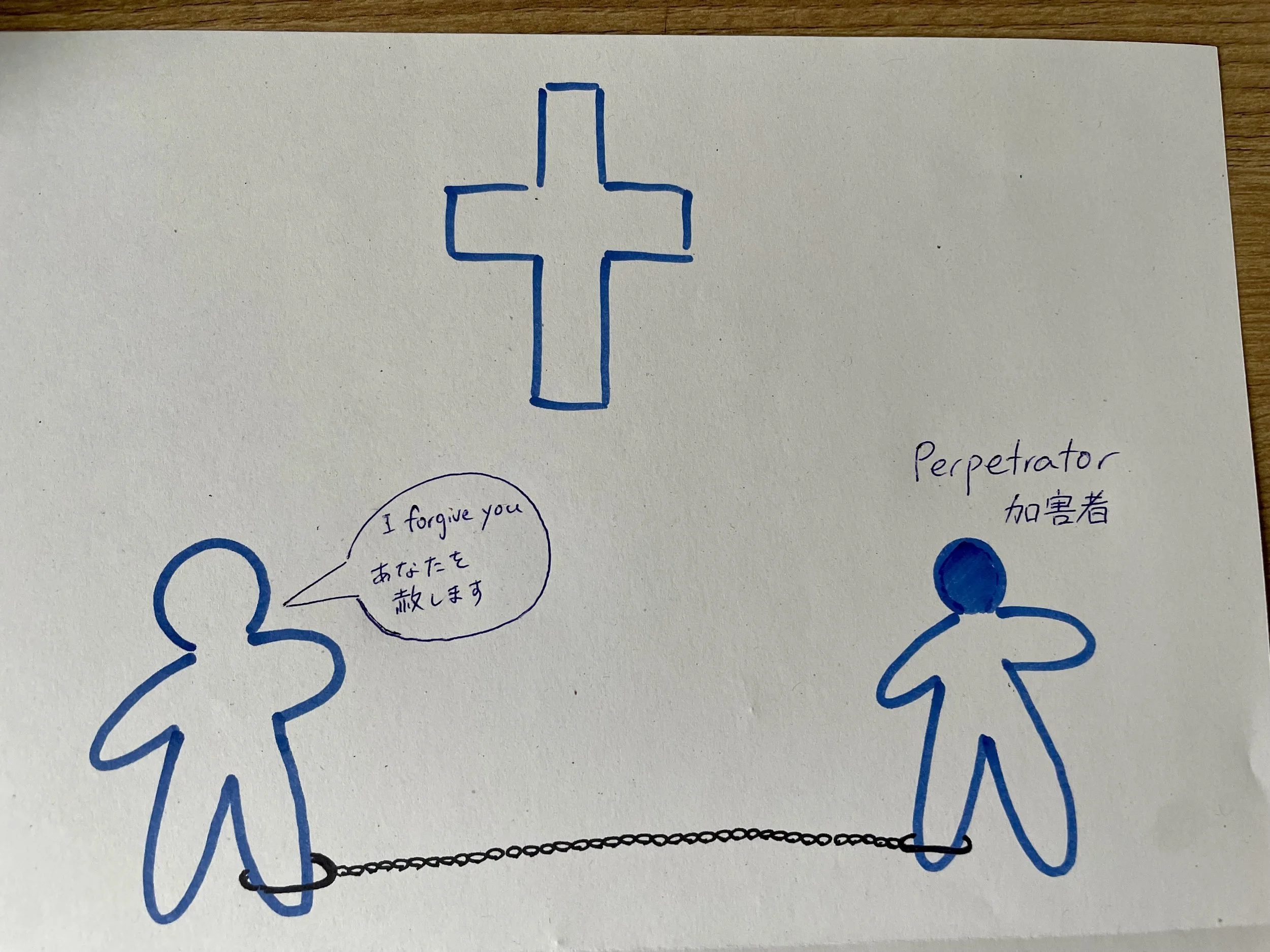
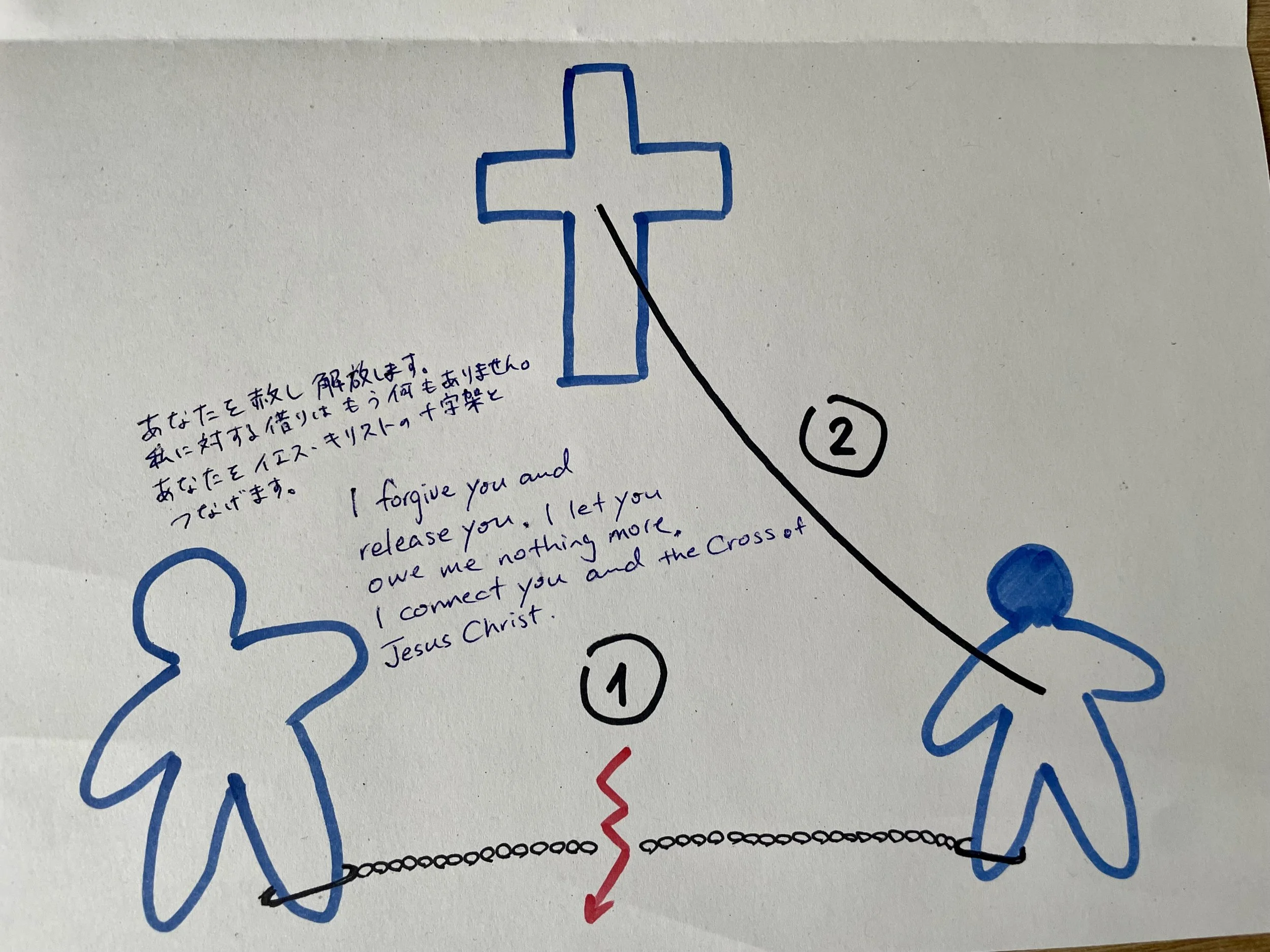
In this sense, this debriefing experience was groundbreaking for me. I learned that forgiveness also involves releasing the ‘perpetrator’ and connecting him/her to the cross of Jesus. Even if you forgive someone, if you do not release them, you remain bound to that person in your thoughts by invisible shackles (See the drawing). But if, because of the cross, you continue to forgive, continue to release, and continue to connect that person to Jesus’ cross (entrusting that person to Him), then God takes responsibility—and you become free. (Romans 12:19–20, John 8:31–32)
I finally left Germany, with amazement at how the roots of various issues can trace back to one’s childhood, and with deep gratitude for the forgiveness and freedom offered in and through Jesus Christ. After the debriefing, I sensed a ray of hope that I might finally emerge from my ministry slump.

先月、左足の親指が腫れて歩くのも困難になったので、医師に診てもらうと、その場で爪に小さな穴を開けてくれました。すると、炎症によって生じた液体が穴から流れ出し、爪の圧迫が取れ、びっくりするぐらい楽になりました。先日、ドイツで行った、5日間にわたるディブリーフィングは、まるで精神の圧迫が取れる、そのような「治療の時」となりました。
ディブリーフィングとは、教会の文脈に当てはめると、海外派遣や異文化下での活動を行った働き人が、心/メンタルヘルスのケア・派遣先で得た教訓の共有・今後の働きの方向性を模索するため、過去の経験・精神的負担・感情を建設的に振り返る作業のことです。
派遣先では、もちろんポジティブなこと、嬉しいこともたくさんありますが、このディブリーフィングでは、基本的に困難なこと、ネガティブなことにフォーカスします。
1日目は、過去5年間に起きたことの「事実」を年代表にしていきます。(事実を5Cでカテゴリー分けする:Change変化, Concerns懸念・不安, Criticism批判, Conflict対立・衝突, Crisis危機)
2日目は、その出来事により自分にどのような影響があったかを列挙していきます。
3日目は、その出来事によりどのような感情が生まれたかを書き出します。
4日目は、その出来事・影響・感情によって生じた『嘘』を信じ込んでいないか、神さまに訊きながら、嘘の洗い出しをします。
そして最後に、祈りの中で、その嘘を一つ一つへし折っていき、聖書の真理と置き換えていきます。
他の人も関わってくることなので、ディブリーフィングの内容の言及は、もちろん避けますが、そこで得た発見の一つをシェアしたいと思います。キリストのからだの誰かにとって、少しでも助けになれば嬉しいです。
僕は基本的に「人」が好きで興味があり、年齢、性別、国籍、宗教、言語など問いません。しかし、ごく稀に、苦手な人、俗に言う「嫌いな人」がいます。40年生きてきて、今まで5人そのような人がいます。「自己主張が強く威圧的、裏表があり、リスペクトに欠け、陰口を叩き、グループの和と調和を乱す」というのがこの人たちの共通点です。5人のうち2人は何度も“赦している”のに、事あるごとに思いの中でトリガー(引き金)がひかれ、ネガティブ思考の渦に飲み込まれそうになります。
僕が人間関係で最も精神的ダメージを受けるのは、「無視される」ことです。挨拶しても返答がない。メッセージ書いても返信がない。既読になっているのに返信ないとダメージ2倍です。(僕も人からのメッセージを“無視”することがあると思うし、僕のことを苦手・嫌いな人もいると思うので、お互い様なのですが。)
何年も前から、なぜこの5人のようなタイプの人が苦手なのか?なぜ無視されることにダメージを受けるのか?ずっと気になって、神さまに答えと解決策を祈り求めていました。ある日のディブリーフィングの中で、「この5人のような人と接する中で自分が無意識に受け取るメッセージは何?なんで無視されたらそんなダメージ受けるの?」という問いに迫られました。祈りの中で答えを求めていると、「I’m nobody(私には価値がない」というフレーズが心に浮かびました。そして幼い時の父親とのエピソードが回想されました。
父はいわゆる「勉強がよくできる人」で、勉強ができない長男と勉強が得意な1歳半年下の長女をしばしば比較するのでした。妹は文武両道で赤ペン先生への道へ、僕はというと赤点街道まっしぐら。ある日の夕方、父と妹と3人で買い物に行くため乗車するや否やダメ出しが始まりました。この日の批判はエスカレートし、侮辱と人格否定で自尊心はズタズタ、小学生には普段大きく感じたトヨタの8人乗りエスティマは、狭い牢屋のように思え、逃走したいけど、走行中の獄中からは逃げられない苦しみを覚えています。
父親に自分の存在価値を認めさせるには、「成果を出すしかない」とこの時、(今抜け出そうとしている)成果主義の芽が出たのかもしれません。(2025年12月のブログ参照)そんな父も早くにこの世を去り、今では過去のことを話すことはできません。(亡くなる2ヶ月前にイエスさまを受け入れ、洗礼を受けたのは、神の奇跡・なぐさめです。)
しかし冷静になると、無視されたって大したことないのです。そもそも悪気がなかったり、わざと無視していないことの方が多いでしょう。ただ単に、(挨拶に)気づかなかったとか、忙しかったとか、忘れていたとか、返信しなくても大丈夫と思った、とか。また、上記5人のような人をなんとも思わない人も多くいるはずです。ところが、僕は過去の経験や間違った解釈から、嘘のメッセージ「I am nobody」を受け取り、過去の傷がうずいてしまう。傷に触れないために、存在価値を示すために、成果を出さなければと躍起になっている部分があるのかもしれません。
ディブリーフィング最終日、この嘘を祈りの中で砕き、神さまの御言葉と置き換えました。I’m nobody → 私は神に愛されている、神の子(ローマ8章38-39節、ヨハネ1章12節、ガラテヤ3章26節)。
そして、5人の人を祈りの中で、赦しました。でもそれは今まで何度もしてきたことです。それでも思い出す度に苦々しい思いになっていたのです。その点、今回のディブリーフィングは画期的でした。赦しには、解放することと、「加害者」とイエスさまの十字架をつなげることを学びました。仮に加害者を赦しても、解放しなかったら、あなたはその人と思いの中で未だ見えない足かせで繋がったままです。(絵を参照)しかし、十字架ゆえに加害者を赦し続け、解放し続け、その人とイエスさまの十字架と繋げ(その人を神に委ね)続けるなら、神さまが責任を取ってくださり、あなたは自由になっていくというレッスンでした。(ローマ12章19-20節、ヨハネ8章31-32節)
自分の幼少期まで、さまざまな問題の原因がさかのぼることの驚きと、イエス・キリストにあって赦しと解放が提供されていることへの感動をもって、ドイツを後にしました。今回のディブリーフィングを経て、ミニストリーのスランプから抜け出せるかもしれないと一筋の光を感じました。